

Automatica
The triumph of human-robot collaboration
Human-robot interaction plays a central role at Automatica. It is clear that the future of human-machine collaboration is bright.
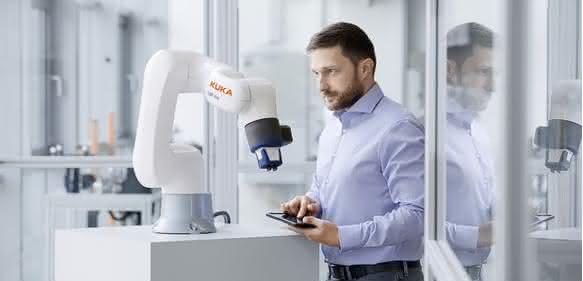
It is hard to imagine today's production environment without automation. In most cases, the degree of automation is fluid: industrial robots are gradually taking on more and new tasks and working ever more closely with humans. Human-robot collaboration, or HRC for short, is becoming an integral part of automation.
Direct collaboration between humans and robots is taking place, particularly in areas that were previously barely automated. A classic example of this is the automotive industry: 95 percent of processes in body shell construction are automated, with only five percent being carried out manually. In final assembly, the situation is exactly the opposite. There, activities that require a great deal of strength or are ergonomically disadvantageous for humans can be made noticeably easier by assistance robots. However, this requires a new generation of robots that can work safely with humans - even without safety fences. These robots are already in use in engine and gearbox assembly as well as in final assembly, but there is also potential for human-robot collaboration in numerous other industries and application environments.
Safety in the collaboration between humans and robots
Robots must have special characteristics in order to work smoothly with humans. Their ergonomics must be designed for direct contact with humans. In addition, the robot must be able to limit its speed in order to minimize the kinetic energy stored in the system and reliably detect impending collisions. Integrated sensors in all robot axes ensure that the robot can "feel" the environment and react to it immediately.
In HRC applications, however, the entire application and the associated environment must be considered. In order to ensure low-risk collaboration, the joint workplace of humans and robots must meet the necessary requirements beyond the safety of the robot. This requires safe cell concepts. Last but not least, the worker should feel safe and thus develop the necessary acceptance for his assistant.
Human-robot collaboration in the smart factory
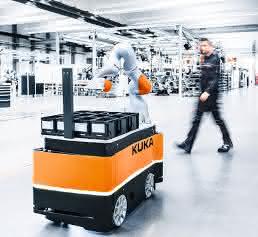
Combining HRC and mobility is the next logical step to ensure that the production of the future offers maximum flexibility. If the strengths of a sensitive lightweight robot are combined with a mobile and autonomous platform, the robot becomes a location-independent and flexible production assistant with an unrestricted workspace - a very good prerequisite for the requirements of Industry 4.0.
People, machines, robots and conveyor systems are also closely networked in logistics centers in order to efficiently control material flows. Sensors and networked IT systems enable each component to make decisions about the course of the supply chain at the right time. In an automated item picking application, for example, collaborative robots are able to pick items provided by storage systems directly from bins using an integrated modern image processing system. This allows humans to concentrate on tasks that serve to refine the process.
In production, humans and robots can form a productive team with the help of HRC solutions. The human is and remains cognitively superior, is creative and works as a strategist, while the robot contributes its repetition accuracy, strength and endurance to the collaboration while maintaining prescribed safety standards. Its capabilities will continue to improve step by step: Robots will become better and better at working directly with humans, mastering gesture and voice control, perceiving their environment and integrating themselves intuitively into changing processes. Intelligent machines will be mobile and capable of learning, sharing knowledge, acting in a swarm and thus playing a key role in the factory of the future.
New lightweight robots are optimized for HRC
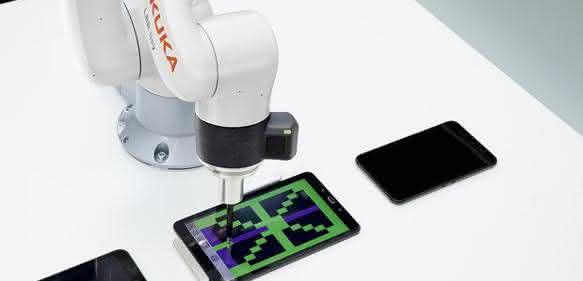
In order to meet future requirements such as easy handling and flexible manufacturing processes, robot manufacturers are launching new lightweight robots, or LBRs for short. Kuka is no exception. With the sensitive iisy lightweight robot, the Swabian robot specialist is expanding its portfolio in the field of human-robot collaboration in the low payload range. The prototype of the LBR iisy will be presented to a wide audience at Automatica.
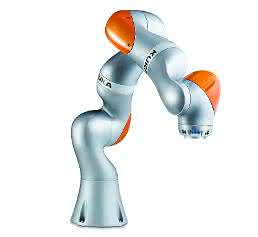
Following the LBR iiwa, the world's first series-produced sensitive lightweight robot for industry, series production of the automation specialist's second sensitive robot will start in 2019.
A robot for everyday work
As the name suggests, the LBR iisy is easy to use: It is aimed at a target group that has process knowledge, but not necessarily programming knowledge. Programming the LBR is quick to learn, easy to understand and can be implemented immediately.
The user-friendly system adapts to the user's level of expertise with different operating levels - from Java programming to simple teaching of the cobot by hand. This principle is intended to pave the way for robotics in everyday working life in the long term.
The LBR iisy is suitable for frequently changing automation tasks where fast reactions are required in the process. It is designed for simpler assembly tasks, while the LBR iiwa can also perform more complex tasks in the payload range up to 14 kg. The two robots complement each other. The LBR iisy supports all essential industry standard functions, such as OPC UA, fieldbus protocols, digital and analog I/Os, safety and much more. This means that the LBR iisy can be integrated into existing industrial environments. The iisy weighs 18.8 kg and meets PL d / Cat 3 safety requirements. With a reach of 600 mm, the new lightweight robot has a payload of 3 kg. It can be used in a very space-saving manner and offers optimum utilization of the workspace. Commissioning should take less than 30 minutes and reprogramming for new tasks should be quick and easy. Another advantage: even in the event of unplanned interruptions, it remembers every movement or activity carried out and can resume work ad hoc without having to be retrained. Its six axes contain the joint torque sensors that are already used in the LBR iiwa.
According to documents from Kuka / ag
Automatica, Hall A5, Stand 221


You might also be interested in
Hamburg Regional Court issues preliminary injunction against Elite Robots Germany
In the copyright dispute between Teradyne Robotics and Elite Robots Germany, the Hamburg Regional Court has issued an interim injunction. The distribution of the software and products concerned is prohibited, and there is also a comprehensive...
 read more...
Schunk founds tech spin-off for humanoid robot hands
Schunk is bundling its activities in humanoid robotics by founding its own spin-off at the beginning of January. The aim of the new company is to develop modular humanoid robot hands for industrial applications.
read more...Partnership for humanoid robotics
Schaeffler and Neura Robotics jointly develop humanoids
Schaeffler and Neura Robotics will work together in the future to develop and supply key components for humanoid robots. The systems will also be integrated into Schaeffler's global production network.
read more...Yaskawa at the Automatica 2025
AI meets robotics
At this year's Automatica, everything at Yaskawa revolves around AI-based robotics solutions for the smart factory and beyond. As a trade fair highlight, the manufacturer is presenting its new Motoman Next product concept.
read more...Kassow Robots at the Automatica
7-axle vehicle in action
At Automatica, Kassow Robots will be presenting a wide range of industrial applications for production and logistics tasks that provide new impetus for efficiency and flexibility in industrial automation.
read more...Robotics and automation in six exhibition halls
From June 24 to 27, 2025, Automatica, the trade fair for intelligent automation and robotics, will bring industry and research together in six exhibition halls. Preparations are in full swing.
read more...Interview with Jörg Rommelfanger
Robotics in 25 years
The annual IFR report shows that the number of industrial robots is steadily increasing worldwide. They have already played an important role in ABB's portfolio for decades. In an interview with INDUSTRIAL Production, Jörg Rommelfanger, Head of...
read more...Reliable end effector for cobots
Collaborative robots are now widely used for a wide range of handling tasks. SMC offers three versions of the RMH pneumatic gripper for this purpose; it is compatible with cobots from a total of twelve companies.
read more...7-axis cobots with controller in robot base
With the Edge Edition, Kassow Robots has launched the world's first 7-axis cobots with a controller integrated into the robot base.
read more...