

Retrofit for welding robots
Retrofit instead of buying new
Today, welding robots have become an integral part of the production facilities of many metalworking companies. In the 1980s, however, hardly any companies knew or used this technology. Yaskawa installed one of these welding robots at wheelchair specialist Meyra in 1986. This robot, a V12B-RX welding robot, has now been in use for over 30 years.
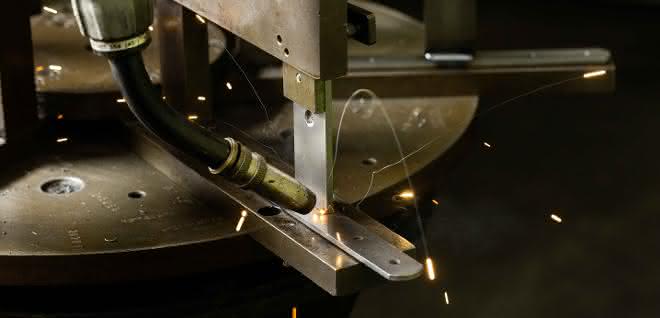
There is more high-tech in a wheelchair than you might think at first glance: around 12 meters of tubes and other bar material have to be cut, bent, drilled, welded, coated and assembled for each wheelchair. One of the best-known and most successful wheelchair manufacturers and also a supplier of rehabilitation aids is Meyra, which was founded over 80 years ago and is based in Kalldorf. The globally active company produces wheelchairs and rehabilitation aids of the highest quality on an area of over 30,000 m². Under the claim "We move people", Meyra enables people with disabilities to achieve mobility and independence through customized solutions. The innovative spirit of the wheelchair specialist is reflected not only in the constant further development of products and services, but also in the choice of production machinery. For example, Meyra was one of the first companies to use a welding robot in production. This robot has now been welding reliably and to the highest quality standards for over 30 years.
Robots as production drivers
The demand for high-quality wheelchairs increased so rapidly in the 1980s that Meyra moved to larger premises. Production began at the Kalldorf site in 1984. Tell Putsch, Operations Manager at Meyra, looks back: "The production figures increased rapidly even after the move to Kalldorf. As a result, the newly occupied factory halls and staff were working at full capacity within a very short space of time. Our company had to find new, innovative approaches in order to complete all orders in the usual high quality and within the agreed time frame. We found the solution with robot specialist Yaskawa, which was producing its first welding robots at the time." The then brand new V12B-RX significantly increased Meyra's production capacity and also made the pioneer in wheelchair technology a pioneer in robot welding technology.
Welding robot V12B-RX
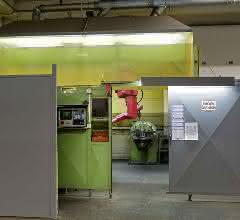
The six-axis robot with a payload of 12 kg and a repeat accuracy of 0.2 mm set standards in the areas of precision and output. Even back in the 1980s, Yaskawa was able to make the robot so user-friendly that Meyra employees were able to program the welding robot themselves after a brief introduction by a Yaskawa robotics professional. The robot's first operator has already retired, but the robot is far from thinking about quitting.
Gerd Hunger, Head of Prefabrication and himself a long-time programmer and operator of the Yaskawa welding robot, on working with the V12B-RX: "The welding robot used to be operated continuously in two shifts. We have been using the V12B-RX less for about eight years now. Nowadays, the trend in production is towards individual production. This requires more manpower and fewer robots. Nevertheless, the V12B-RX is still used regularly. Whenever larger quantities of the same component, for example wheelchair frames or small parts, need to be welded, it is there to help. The quality of the weld seams has not diminished after more than 30 years, and apart from a few wear parts, we haven't had to repair anything on the robot."
Retrofit as an economical alternative to buying new
It is no coincidence that the V12B-RX welding robot delivers high-quality weld seams even after more than 30 years. Product longevity has always been an integral part of Yaskawa's corporate philosophy. With a focus on sustainability and cost-effectiveness, the Japanese robot specialist has developed systematic retrofit programs that breathe new life into old robots.
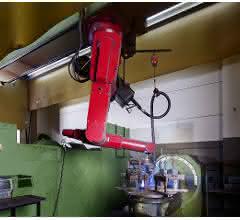
A growing awareness of costs and resources has led to industrial production facilities being used for longer and longer periods. The probability of a machine failure also increases the entrepreneurial risk. In the event of a breakdown, production may be at a standstill for several days. The solution is often to replace old robots with new ones. Yaskawa offers systematic retrofit programs for outdated robots as an attractive alternative to buying new ones. The robots are overhauled as scheduled on a specific date or replaced with an already overhauled robot. On average, around 60 percent of a robot's wear parts are completely new after the retrofit.
Due to the high stress caused by the constant movement, the manipulators are the focus of most retrofit measures. They are completely cleaned, repainted, put through their paces in a 24-hour test run and recalibrated. A fixed price based on the load capacity of the robot offers investment security. In addition, Yaskawa extends the warranty on replaced components by one year.
Markus Kern, Key Account Manager Automotive / OEM at Yaskawa Europe / ag


You might also be interested in
Conrad continues to grow
Conrad Electronic now generates 80% of its sales with business customers and has successfully developed from a traditional technology retailer into a B2B procurement platform. The company aims to become Europe's leading procurement platform for...
 read more...
AI finds its way into automotive customer service
In addition to computer solutions for vehicle diagnostics, Getac now also offers AI-based digital tools that support customer contact in service operations.
read more...SMC: "Preferred Supplier" from Bosch
The technology and service company Bosch has recognized SMC for the performance of its automation technology in factory and process automation and awarded it the status of "Preferred Supplier" in the material group "Standardized Pneumatic Devices".
read more...Combined ERP forces
The medium-sized ERP providers Step Ahead Software, Godesys and Informing merge to form the Step Ahead Group.
read more...Cybersecurity for asset-intensive companies
Forge Cybersecurity Platform, the new software platform from Honeywell, has been developed for the cybersecurity of asset-intensive companies and critical infrastructures. The platform is available in three versions.
read more...Automated machine tool as a success factor
Industry 4.0 is the hot topic of the moment. For small and medium-sized companies and contract manufacturers, it holds great potential for increasing production efficiency step by step. The focus here is on efficient and user-specific automation...
read more...Nemo hand vacuum lifts all materials
A new addition to the Eurotech portfolio is the battery-operated Nemo vacuum cleaner, which is suitable for handling almost all surfaces.
read more...Future-oriented cobot projects
Three pillars of successful cobot initiatives
What is important if cobot projects are to be future-oriented? Automation and robotics expert Omron has identified three aspects for human-machine collaboration.
read more...Short-stroke linear actuator instead of pneumatic cylinders
The new short-stroke linear actuator from Ketterer Antriebe and halstrup-walcher is characterized by high dynamics and a large stroke in a compact size. Thanks to the integrated electronics, the drive is easy to control compared to pneumatic...
read more...