

Automatica 2018
Industry meets Intelligence
Intelligent automation concepts and robotics solutions are the focus of Automatica in Munich. In addition to technological developments in the field of intelligent production, the role of humans in the factory of the future will also be discussed. By Andrea Gillhuber
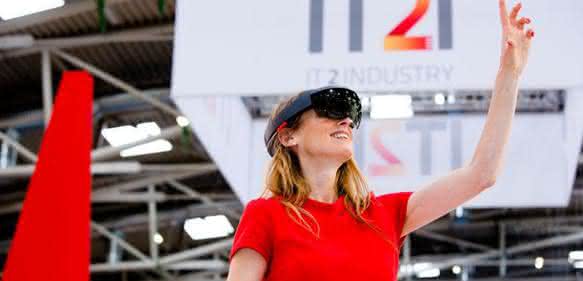
The digital transformation is enabling industry to make series production ever more flexible and cost-efficient. Due to the digitalization of the entire product life cycle, from design to production and shipping, IT has become an important link in intelligent production. Automatica, the international trade fair for intelligent automation and robotics, which will take place in Munich from June 19 to 22, 2018, will showcase a wide variety of production concepts. In addition to industrial and service robotics, assembly and handling technology, image processing systems and components, intelligent automation solutions will also be on display. Always present: the human factor in the production of the future.
IT2Industry demonstrates the important role IT plays in industry and networked production; this topic area has been integrated into Automatica.
Industry meets IT
In a combination of lecture program and exhibition, more than 50 exhibitors from the classic IT sectors, but also special providers from the industrial environment, will present their solutions for the Industrial Internet of Things.
SpaceNet is also one of the exhibitors. Founder and CEO Sebastian von Bomhard explains why the hosting and cloud specialist is taking part in the special show: "IT2Industry brings IT and intelligent production automation together. We find this approach interesting in times of Industry 4.0 and IoT. We want to show that cloud computing and connectivity are also relevant topics for production that will further advance manufacturing in terms of automation and efficiency. IT2Industry is an excellent platform for this."
With the changes in production, digitalization also brings new business models. In order to secure a competitive edge, companies are forming innovation partnerships. The aim is to drive forward new developments together. The special show "Platforms and Ecosystems" picks up on this trend. Presentations and models and prototypes will explain how the technical and economic potential of the IoT can be realized in companies.
Another new discussion platform is the "Smart Maintenance Pavilion". Here, interested trade visitors can gather everything they need to know about maintenance from a compact mix of information, practical examples and field reports. On the one hand, real applications will be on display on the exhibitor side and in the Maintenance Demo Park, and on the other, in-depth specialist knowledge will be imparted in presentations at the IT2 Industry Forum and at the "Meet the Experts" meeting point. Valuable insights will be provided by companies such as Acoem, IAS Mexis, Softgate and Sogema.
OPC Day Europe conference at Automatica
Together with partners, the OPC Foundation will be showcasing current solutions relating to the OPC UA communication standard for manufacturer-independent communication in production. On June 22, the OPC Day Europe conference will also take place for the second time as part of Automatica. Successful business models for Industry 4.0 and IoT will be presented in specialist presentations and discussions at the IT2Industry Forum. Companies such as IBM, Connyun and TÜV Süd will provide insights into their Industry 4.0 strategies. Current research results from the IIoT environment will be presented by universities and research institutes. The Chaos Computer Club will also comment on cybersecurity in times of billions of insecure IoT devices. In three panel discussions, analysts, practitioners and researchers will discuss topics such as IoT platforms and business models as well as artificial intelligence.
Humans and their colleague robots
With full automation, robots have finally established themselves in production. In the beginning, the industrial helpers were still physically separated from the workers by safety fences, for example. Over time, the physical boundaries were removed and virtual safety fences led to the coexistence of humans and robots in production. Interaction of any kind during operation was not desired.
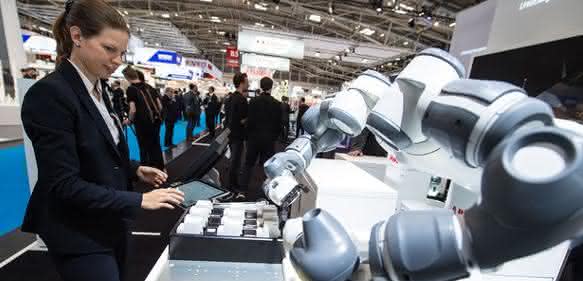
This changed over time. Gradually, there was cooperation between the worker and the robot. They share at least one workspace; interaction does not usually take place. Human safety is ensured, among other things, by reducing the robot's path speed or by active workspace monitoring. Human-robot collaboration brings down the last virtual or real safety barriers. Humans and robots consciously work together in the same workspace and on the same object. Lightweight robots such as ABB's Yumi or Kuka's iiwa are generally used for this type of collaboration.
From research to production
However, robots are not only becoming increasingly popular in production. Human-robot interaction has long since discovered other fields of application. The importance of the technology is also evident from the fact that MRI has been defined as one of the four core technologies of robotics in the European Commission's Horizon 2020 work program, or H2020 for short. A total of 66 million euros is available for the program in the period from 2018 to 2020. Martin Hägele, Head of the Robotics and Assistance Systems department at the Fraunhofer Institute for Manufacturing Engineering and Automation IPA, explains: "MRI is a key technology for both industrial and service robotics. Robots can be used by both service companies and end users, particularly in agriculture and logistics, healthcare, the security sector and retail. Almost all of these applications have one thing in common: they work without a safety fence. Therefore, robots in everyday environments must meet special safety standards and be safe and intuitive to operate. The MRI is therefore an important component."
A wide variety of application scenarios for human-robot interaction can be seen at Automatica, from industrial applications to service robotics and intelligent assistance systems. Fraunhofer IPA will also be presenting solutions, including the bp3TM software specially developed for "reaching into the box". The software has already proven its worth in over 12 production systems and will be on show in action in Hall A4, Stand 101. Applications from the research institute will also be on display in the special exhibition area for service robotics in Hall B4. These include the RoboPORT project, which is creating an online development platform for service robotics with a library of open source robotics hardware.
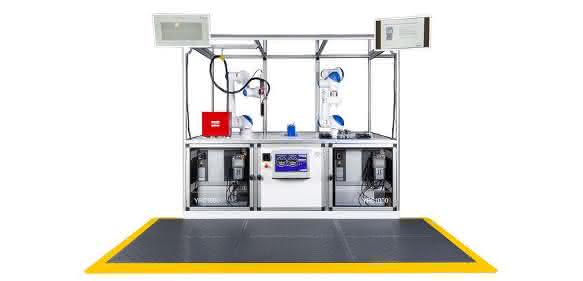
Under the label "Human Collaborative", or HC for short, Yaskawa is exhibiting two Motoman HC10s with a reach of 1.2 m and a handling weight of 10 kg. They are used both in standard applications and in collaborative applications. At Automatica, the two lightweight robots are equipped with HRC grippers and an automatic screwdriver in HRC design and will be demonstrating in a demo cell (Fig. 2) how they assemble bottle openers and distribute them to visitors to the stand. The system is controlled via the company's own Vipa touch panel. The required safety in direct contact with the operator is ensured by a six-fold force and torque monitoring system.
Fanuc is also focusing on individual solutions between fully automated and manual work. The robot specialist will be presenting the SR-6iY for the first time, a 6 kg version from the new Scara series. Fanuc presented its first model, the SR-3iA, at the beginning of the year. This model is also controlled by the new R-30iB Compact Plus controller. Other features include the integrated iRVision image processing system and the iRPick Tool and Line Tracking functions for pick & place tasks.
Industrial image processing makes it possible
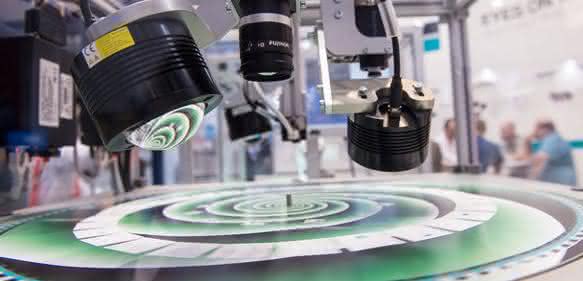
Machine vision is currently establishing itself as an enabling technology. It is opening up new fields of application for automated processes in many areas of industrial production. It is no longer just a stand-alone solution in quality assurance, for example, but has long since become an integral part of automation. Among other things, it serves as the basis for human-robot interaction and collaboration. Trends such as the digital transformation of manufacturing, assistance systems in production, embedded and robot vision, deep learning and 3D image processing are ensuring steady growth in the machine vision industry.
Embedded vision is certainly one of the most important trends here. The technology is already being used successfully in the automotive sector, for example in the form of driver assistance systems. Embedded vision systems are usually simple camera modules that are integrated directly into vehicles, machines or devices in conjunction with high-performance computer platforms with low power consumption.
Deep learning also plays a major role in the context of image processing. This refers to machine learning: a system is trained to recognize good and bad images so that it can then automatically assign inspection objects to the learned categories and decide on the quality of inspected components, for example. Classification tasks can thus be solved without the manual adaptation of operators.
People in the factory of the future
With technological progress in all areas of production and the associated changes in society, the role of people in the smart factory is also changing. Work 4.0 is the buzzword here. At Automatica, the VDMA Robotics + Automation Association will be looking at where people will bear responsibility in the future. The special show "Humans in the Smart Factory" will address current issues. For example: How can humans remain the focus? What role do "analog" people play in the digital factory?

At the special show, visitors will learn, for example, how productivity can be increased through optimized cooperation between humans and robots or how workplace conditions can be improved. Patrick Schwarzkopf, Managing Director of the VDMA Robotics + Automation Association, explains: "Human dexterity and adaptability will remain unrivaled, but assistance systems will bring manual assembly processes to the required zero-defect quality for the first time. Communication between man and machine will become intuitive, and the combination of man and machine particularly powerful. Workplaces will become more ergonomic and interesting than ever before."


You might also be interested in
ESTIA aims to strengthen Europe's cloud
New tech alliance for EU sovereignty
Twelve companies, including Dassault Systèmes, are founding the European Sovereign Tech Industry Alliance (ESTIA). The initiative aims to strengthen Europe's technological independence and define requirements for sovereign cloud services. The start...
 read more...
Deutsche Telekom and Nvidia launch one of Europe's largest AI factories
With the Industrial AI Cloud in Munich, Deutsche Telekom and NVIDIA are creating one of the largest AI factories in Europe. Companies can train AI models, carry out simulations and access 10,000 GPUs.
read more...Leveraging data potential with AI and streaming
Huge data treasures are still lying dormant in many manufacturing companies. And yet it is high time that these treasures were unlocked. There is often a lack of resources and capacity to make data usable in real time. Streaming production data can...
read more...More awareness of noise
Dematic offers solutions that are tailored to different cloud environments and reduce environmental impact through reduced material consumption and improved energy efficiency.
read more...Generative AI in the automation environment
The mechanical engineering and automation industry is undergoing profound change. This transformation is being driven by more volatile global trade, geopolitical crises and increasing market pressure, which demands greater agility, technological...
read more...Rigid data structures have had their day
The traditional data center is no longer the center of data. A hybrid cloud storage approach enables manufacturing companies to both meet the current requirements of data-intensive processes and future-proof their infrastructure.
read more...Software as a service in three stages
CIM Database Cloud is a new out-of-the-box solution from Contact for end-to-end digital product development.
read more...How production can benefit from AI
Together with AI technology, IIoT networking makes it possible to better control machine parameters and optimize quality with predictive quality. Downtimes and set-up times can also be further minimized. Cloud platforms also make these technologies...
read more...More expertise for digital engineering
Altair, a computational science and artificial intelligence (AI) company, has acquired OmniV, a technology from Michigan, USA-based software company XLDyn.
read more...