
Sanding robot
Higher productivity thanks to sanding robots
Sanding car body components, some of which have large surfaces, after filling is essential for outstanding paint quality. While this was previously a difficult processing step, it is now carried out by a robot with a sensitive end effector.
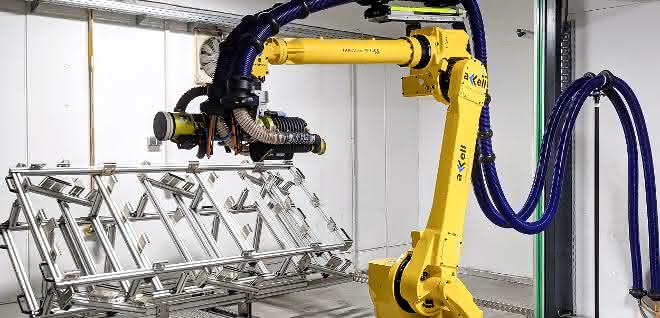
A supplier to the automotive industry that offers, among other things, high-quality manual wet painting in small and medium series production on aluminum, die-cast aluminum and plastics has recently started using a robot for sanding body components. As its customer base also includes leading OEMs, the company has to guarantee consistently high quality and cannot do without intermediate sanding after filling. In order to implement this automation in the best possible way, the family business from central Germany turned to the Austrian company Accell.
Previously, this work was carried out manually, which was associated with problems: dust exposure for employees, unergonomic procedures, working with vibrating tools. Accell from Redlham in Upper Austria has now been able to provide a solution to these problems. A sanding robot now significantly reduces the workload for employees while maintaining the same quality and saving on consumables.
The highlight of the system is its simple operation. Just two buttons are needed to grind different components automatically and in a faster cycle time than before. "Systems that are extremely easy to operate are very important to us. We believe that this is a decisive factor in the acceptance of the technology, especially among small and medium-sized companies," says Sebastian Gottwald, Technical Director at Accell. "In this specific case, the robot itself senses whether and which components have been inserted. Operating errors are ruled out. The team inserts the components, presses the start button and finally checks the finish. Such simple system concepts also reduce costs. We always keep an eye on the cost-effectiveness of our systems for the customer," says Gottwald. This eliminates the need for manual work steps.
Team player with a sure instinct
How can a robot feel the components? The solution is Active Compliant Technology (ACT) from FerRobotics, another Austrian company. This technology is already in widespread use around the world, including for weld seam removal and polishing. In this specific case, the FerRobotics end effector AOK attached to the robot adapts to the complex surface of the car body components at the moment of contact and automatically adjusts the force to be applied without losing contact. "We are delighted to have automated this rather unpopular work step for our employees. For some time now, we have been using intelligent solutions to reduce the workload on our employees, which of course also have to pay off. The shortage of skilled workers is particularly noticeable here in eastern Germany, and we are countering this by automating work steps - wherever it makes sense and the highest quality is guaranteed," says the Managing Director of the supplier company. "As a medium-sized family business, we have to remain competitive and offer our customers high-quality products." Savings potential was also evident in the cost of consumables. The abrasive is used to the end, while the sanding pattern remains high quality.
How exactly does the robot grinding system work? Components are placed in the specifically adapted holders either to the left or right of the robot. A sliding gate is closed and the machining process is started. The robot then scans the components at significant points and then starts the corresponding program. Meanwhile, a new component can be inserted on the other side. In this way, humans and robots work together optimally, while the robot's work area is always closed off from that of the operating personnel. Two securely interrogated high-speed doors with aluminum slats were used for this purpose.
Fast-track to the perfect solution
"The investment was based on the previous tests in Accell's technical center. Original parts were processed on site by the test robot and then inspected by us. This allowed us to be sure that the quality was right before we bought the system. After the tests, the system was designed in consultation with us, change requests were taken into account and implemented quickly. Only 3 ½ months passed between the offer and the start of production. This was very important to us, in addition to quality and cost-effectiveness. As a family business, we have short and fast decision-making processes - we expect the same from our system suppliers," says the Managing Director.


You might also be interested in
Intelligent brownfield networking
Many industrial companies are struggling with established plant structures and proprietary interfaces. Stefan Klaus' presentation will show in a practical way how brownfield environments can be efficiently networked with open technologies and made...
 read more...
Factory-X in practice
How can set-up processes in highly variant production be automated efficiently? Markus Benndorff from soffico shows how Factory-X, industrial data rooms and modular architectures create new possibilities for flexible production concepts.
read more...Mechanical engineering | Case study
Cordless in brush production
The machine manufacturer Wöhler Bohemia is integrating wireless HMI panels from Keba into its brush production systems. The background to this is the need for flexibility, robotics integration and new market strategies.
read more...International product approvals as a strategic competitive advantage in the global market
Which certificates are valid worldwide? Christian Latte, Head of Technical Compliance and Approval Officer at Hummel AG, explains this in an interview. He provides insights into product approvals and explains why early approval strategies shorten...
read more...Foundry modernizes plant park with continuous wire belt shot blasting system
The Spanish foundry Funosa is modernizing its equipment fleet with an RDGE 1250 wire belt continuous shot blasting machine from Rösler. Focus: sand removal from heavy iron castings, energy efficiency, ease of maintenance and ESG strategy.
read more...How bridging steps, stairs and catwalks are changing processes in production and logistics
At Logimat 2026, Munk Günzburger Steigtechnik will be showcasing modular bridging steps, stairs, platform and walkway systems for production, warehousing and logistics. With online configurators, distances can be efficiently shortened, processes...
read more...Drilling cycles optimized
A new replaceable head drill from Walter can reduce machining time in series production thanks to its patented interface and screwless design.
read more...Production, metalworking, robots
Precise 5-axis machining
The new Kern Fortis HD five-axis machining center will provide manufacturing companies with high precision requirements with a new machine from 2026.
read more...Agentless remote access to industrial plants
TeamViewer is expanding its Tensor enterprise platform to include "Agentless Access", enabling secure remote access to industrial systems without the need for local software installation.
read more...