

Driverless assistance systems
Fully automated intralogistics at the ICE plant
At the ICE plant at Munich Central Station, an automated guided vehicle system is used to replenish materials in the maintenance area. The system must be able to cope with extremely complex requirements in order to avoid accidents.
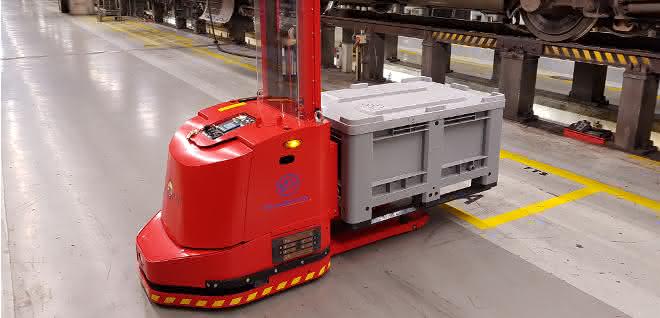
InSystems Automation is supplying the ICE plant at Munich Central Station with a fully automated intralogistics system with an autonomous driverless transport system (AGV). The "proANT AGV 576" will be used to transport pallet cages and Euro pallets between the materials warehouse and the maintenance level.
Special features include the installation of an intelligent parking space management system in the track aisles on the one hand and the connection to the existing elevator system on the other. The aim of the project was to supply the maintenance tracks with material from the warehouse using automated systems. To this end, InSystems developed a driverless transport system that meets the requirements and fits into the complex environment of the ICE plant. The company opted for the proANT AGV 576 primarily because it was no longer able to maintain and find enough skilled workers for the internal material flow supply. The new technology enables fully autonomous supply to the track aisles.
Lithium iron phosphate (LiFeYPO4) batteries are integrated into the transport robot, which can be used for up to six hours when fully charged and have a very long service life. The lithium iron phosphate is non-toxic and non-flammable. In contrast to conventional Li-ion cells, no metallic lithium is deposited when overcharged and no oxygen is released. The vehicle is charged at a 50 A charging station. This has a drive-charge factor of 5, which in turn means that the transport robot can drive for 5 hours for every hour it charges. The AGV can transport 450 m about seven times per hour. It travels fully automatically with the elevator from the basement to the maintenance level to bring the material from the warehouse to the train.
The ICE plant at Munich Central Station was built from 1989 and gradually put into operation until 1995. It is 435 m long, 50 m wide and 14 m high. On a total area of around 36,000m2 there are six hall tracks for carrying out operational maintenance work on high-speed trains. The maintenance work can be carried out on three working levels. Previously, hand pallet trucks were mainly used for transportation, or pallet trucks powered by fuel or lead-acid batteries were used. The distance between the material store and the material stations on the track is between 30 and 450 m.
The autonomous driverless transport system from InSystems Automation is designed to optimize intralogistics in the factory. In an initial configuration phase, the modern pallet truck is moved manually using a built-in joystick. All the distance profiles recorded by the laser scanners are recorded and combined with the data from the motor encoders to create a map of the environment that shows the surfaces of the surrounding objects.
Constant position monitoring
Based on the map created, the route planning is set up using an easy-to-use and flexible visualization. Within the pre-scanned map, the robot is given a virtual line that it follows and does not leave during subsequent operation. Various action commands can be set at defined nodes, so-called goals, such as setting down load carriers, opening doors or checking the status of an intersection. Once the robot is in operation, it starts an initial localization process to determine its current position. To do this, it compares the distance profiles detected by its laser scanners with the corresponding parts of the map. This localization algorithm takes place at regular intervals during autonomous driving operation so that the robot can constantly verify its position and navigate reliably.
In the material warehouse in the basement of the IC plant, a picking area with five load carrier storage locations is created and managed. The storage spaces are marked by yellow lines on the floor and are used to provide pallets for transportation and to store pallets after return transportation. In the track aisles on the maintenance level, three load carrier storage locations are also set up in each of five material stations. A sensor is installed above each parking space so that the robot automatically detects which space is occupied or free at the material station in the track aisle when pallets are delivered. When the vehicle delivers a pallet, the final location is only determined shortly before arrival.
The robot navigates to a so-called "arrival selector" on the taught-in map. Once there, the status of the sensors at the material station is evaluated in the fleet management server. The robot places the pallet in the first free space. If all the load carrier slots are occupied, the vehicle stops and reports an error until a slot becomes free.
On the way to the maintenance level, the vehicle must use the existing elevator system. For this purpose, a coupling PLC was installed in the elevator control room as an interface between the AGV and the elevator. The PLC receives commands from the fleet management server and controls the elevator. The buttons for the manual call are blocked in the meantime. If the travel path is blocked by a forklift truck, the vehicle can be instructed to move to a parking position via a command button.
André Schmiljun, Press and Public Relations at In-Systems / am


You might also be interested in
More than 900 exhibitors already registered
Around six months before the start of the trade fair, more than 900 companies have registered for SPS 2026 in Nuremberg. The trade fair focuses on industrial AI, cyber security and digital transformation.
 read more...
Virtual PLCs in practice: How vPLCs make production systems more flexible and scalable
The increasing networking of IT and OT is fundamentally changing industrial automation. The IT/OT Integration Summit shows how modern technologies can make production environments more efficient, flexible and future-proof. The event will focus on...
read more...Sales growth in a turbulent market environment
Thanks to innovations and a focus on strategic industrial markets, Sick was able to moderately increase its sales in the 2025 financial year. In a turbulent market environment, the company was able to maintain its position and gain market share with...
read more...Siemens presents new AI agent
Siemens is launching 'Eigen Engineering Agent', an AI for automation technology. The solution is integrated into the TIA Portal, has been tested with over 100 companies and is designed to significantly accelerate engineering processes.
read more...Schaeffler keeps sales almost stable
Schaeffler generated revenue of EUR 23.5 billion in 2025 and increased EBIT before special items to EUR 936 million. At 266 million euros, free cash flow was significantly above the prior year and forecast. Net income remained negative due to high...
read more...Advancing artificial intelligence together
Helukabel is stepping up its activities in the field of artificial intelligence and is now a member of the IPAI. The innovation and collaboration platform for companies, research facilities, institutions and administration has set itself the goal of...
read more...New impetus for ifm sales
Two new positions were filled at ifm at the start of 2026: Markus Wolf becomes Managing Director Sales Germany, Sven Quant takes over the position of Central Managing Director in the Process Sensors division within the ifm Group.
read more...Digital twin meets product passport
Future-proof end-to-end solution at SPS 2025
At SPS, conplement and R. STAHL will present how the digital twin works end-to-end along the entire value chain: from creation and provision to productive use.
read more...Changes in the management of Endress+Hauser
Endress+Hauser strengthens its management team: Mirko Lehmann, Katja Windt and Helena Svensson take on central management roles. What is changing in technology, production and personnel.
read more...