

Biodynamic light
Put in the right light
Ergonomics at the workplace goes far beyond choosing the right chair, especially in industry. Although the right posture at the workplace is of great importance to health, one key point is often forgotten in the discussion about ergonomic workstations: the right light! By Florian Schutzbach
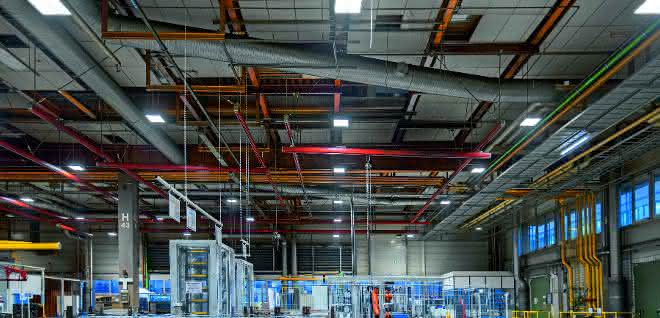
When it comes to ergonomic industrial workstations, the focus is often on the chair, desk or workstation system. Anyone who only focuses on these areas when making specific improvements is overlooking an important point: light plays a key role when it comes to the well-being and health of employees, especially in industry. It is therefore high time to put the issue of ergonomic lighting - literally - in the right light. After all, lighting plays an important role in providing healthy equipment. Light not only facilitates visual tasks, it also creates optimum conditions for communication and concentration. In addition, a high quality of light reduces stress at work, prevents accidents and at the same time improves the performance and well-being of employees.
Ergonomic lighting reduces health problems and lowers visual complaints. Poor lighting conditions, on the other hand, lead to fatigue or headaches. In addition, people often adopt an incorrect posture to compensate for unfavorable visual conditions, which causes discomfort in the neck, back or shoulder area. The lighting conditions should therefore be adapted to the visual tasks. The basic requirements for lighting in indoor workplaces are set out in the DIN EN 12464-1 standard. These requirements are intended to ensure optimum visual performance and the best visual comfort for people with normal eyesight. The standard deals with the usual visual tasks in all indoor spaces, including visual tasks at computer screens. It specifies quality characteristics such as illuminance and the limitation of direct glare and reflection. According to DIN EN 12464-1, sufficient illuminance at the workplace depends on the respective area of activity and does not have to be the same everywhere in the room. The specification divides the working environment into traffic zones and the workplace, for example. The former describes the area surrounding the employee. In some areas, only 300 lux illuminance is required. The actual workplace, on the other hand, is different. Here, the standard specifies higher illuminance levels. For demanding visual tasks, an intensity of 1,000 lux is even required in some areas.
However, it is also important to ensure that the central and peripheral fields of vision are evenly illuminated so that there are no excessive differences in brightness between the surroundings and the workplace. These can have a tiring effect and disrupt well-being. Glare must also be reduced. A distinction is made here between direct glare and reflected glare. Direct glare is caused by unsuitable or incorrectly positioned lighting. Reflected glare is caused by reflections on shiny surfaces.
Important: The DIN EN 12464-1 standard only describes minimum requirements. And it only refers to the requirements that a healthy eye places on illuminance. For example, there is currently no standard that takes into account age-related impairments in contrast perception. The following therefore applies in any case: the better the lighting quality, the greater the well-being and performance of employees.
Ergonomic lighting in industry
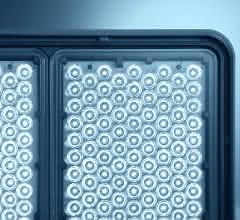
Disturbance-free vision is therefore the primary goal in production and at assembly workstations. High-bay downlights, such as Acaneo from Waldmann, ensure homogeneous hall illumination with low glare. These enable efficient illumination of production and logistics halls up to 30 meters high. The downlight can be dimmed continuously as required. Its daylight and presence sensors and the option of connecting it to building management systems also offer additional convenience and energy-saving options.
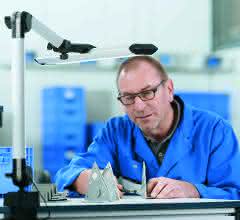
For optimum illumination of the workplace, we recommend special lights that are tailored to specific visual tasks and offer adjustment options through individual positioning or dimming. For precision work, magnifying lights support close-up vision. This prevents unnatural bending forward - a typical incorrect posture that employees adopt when the lighting is not sufficient for their visual tasks. On the other hand, a rod or system luminaire enables unobstructed vision at close distances of 40 to 80 cm. Appropriate mounting and easy handling allow the user to direct the lighting in different directions and distances to the desired visual area. The German Campaign for Healthier Backs (AGR e.V.) provides guidance on whether lights are particularly ergonomically suitable with its seal of approval. The ergonomics specialists have awarded this seal to the Taneo rod and system light and the Tevisio magnifier light from Waldmann.
When it comes to maintaining the health, well-being and performance of employees, the biological effect of light in particular offers valuable support. Knowledge of these connections is relatively new. Light clocks the human body clock.
Biodynamic light in the industry
In nature, this task is performed by daylight. In buildings and industrial plants, light entering through windows is often not enough to make its biological effects perceptible at the workplace. The solution: bio-dynamic lighting - artificial light that imitates the natural course of daylight. However, unlike in the office, where practical solutions for biodynamic lighting already exist, there is still a lack of them in industrial lighting. The main obstacles to biodynamic lighting solutions in industry lie in the specific spatial conditions and working time models such as shift work. Waldmann is working on this topic under scientific supervision: the first phase of a pilot project investigating the effect of biological light in industrial buildings in practice was recently launched. Initial results are expected from the middle of next year. Application-specific product solutions can only be developed once the key unanswered questions have been clarified.
Florian Schutzbach, Product Manager at Herbert Waldmann / ag


You might also be interested in
Robotics and autonomous order picking
Locus Robotics acquires Nexera Robotics and expands autonomous warehouse logistics
Locus Robotics takes over Nexera Robotics and may have taken a decisive step towards truly universal warehouse automation. A new gripping technology should now make possible what was previously considered difficult to automate.
 read more...
How bridging steps, stairs and catwalks are changing processes in production and logistics
At Logimat 2026, Munk Günzburger Steigtechnik will be showcasing modular bridging steps, stairs, platform and walkway systems for production, warehousing and logistics. With online configurators, distances can be efficiently shortened, processes...
read more...Highly automated warehouse for...
SSI Schaefer implements highly automated warehouse for CERP in France
SSI Schaefer and CERP are building a highly automated logistics center for pharmaceutical logistics in Wissous with shuttle storage, A-Frame, robotics and WAMAS software.
read more...Start of construction for new production hall
Mayr Antriebstechnik invests in its home base and internationally
Mayr Antriebstechnik strengthens location and international logistics: Construction of a new hall in Mauerstetten - parallel expansion of the plant in Poland as a logistics hub.
read more...Conveyor systems that adapt
Modern conveyor systems must reliably transport different product sizes, shapes and materials. The new modular product system from Kipp offers flexible, modular solutions for this: Adjustable side guides ensure precise alignment and gentle...
read more...Focus on sustainability and AI at the trade fair
With more than 120,000 square meters of exhibition space, LogiMAT 2025 will once again occupy all ten halls of the Stuttgart exhibition grounds. From March 11 to 13, global players, medium-sized companies and start-ups will provide an overview of...
read more...Workstation system for shipping and logistics
With Sintro Packing, Karl is launching a workstation system that is designed to meet the specific requirements of shipping and logistics. It is characterized by modular adaptability and ergonomic efficiency.
read more...Deutsche Messe announces Robotics Award
On the occasion of Hannover Messe 2025, Deutsche Messe is once again presenting the Robotics Award after a break of several years. Prizes will be awarded for robot-supported automation and logistics solutions. Companies and institutions from Germany...
read more...Micro motors as the driving force behind intralogistics
Suitable transport structures in intralogistics are a prerequisite in all industries in order to withstand competitive pressure in the future. The basis for this is comprehensive automation, which would be inconceivable without an armada of powerful...
read more...