

ABB and Solar Materials
Circular economy in the solar industry
Solar modules supply electricity for decades - and then often end up as hazardous waste. The Magdeburg-based cleantech company Solar Materials wants to change this and is relying on industrial robotics from ABB. Five six-axis IRB 6700 robots are now automating the first steps of the recycling process, which allows up to 98% of the raw materials to be recovered - a significant step forward for sustainability in the industry.

Used solar modules contain valuable raw materials: glass, silicon, silver, copper and plastics. In practice, however, recycling is often only partially implemented for cost reasons. Only high-quality solar glass is regularly given a second life, for example as foam glass or as a filler in building materials.
With a recycling rate of up to 98% of the total solar module weight, the Magdeburg-based cleantech company has set itself the goal of making the circular economy in the solar industry more efficient. "For sustainability initiatives to be put into practice, they must be economically viable. To achieve this, the PV recycling process must be thoroughly optimized in terms of cycle time, material flow and accuracy," explains Jan Bargel, co-founder and CTO of Solar Materials. The necessary precision and efficiency is achieved through automation. The company chose ABB Robotics as its automation partner.
Handling delicate freight ergonomically and economically with robotics
"When our partner delivers the panels for processing, some of them have been standing in an open area for decades," reports Bargel. This means that some of the panels are covered in mud or other foreign objects. "The most unusual thing we once found on a module was a bees' nest - fortunately no longer inhabited," smiles Bargel. The U-shape of the frames also means that rainwater collects in the modules, which means that a panel originally weighing 20 kg can quickly double in weight - a considerable burden for the employees.
Manual handling is not only ergonomically stressful and error-prone, but also increases safety risks. In addition to reducing the physical strain on employees, cost efficiency is a key factor: the material value of a recycled solar module is limited. High quantities and a smooth process are a prerequisite for cost-effective recycling.
The required ergonomics, precision and timing of the process can only be achieved through automation. In the search for a partner, the choice fell on ABB Robotics. The system integrator commissioned by Solar Materials appreciates the simple programming and integration capability of ABB robots and initially implemented a pilot system with a used industrial robot from ABB. Positive experiences in terms of reliability and operability led to the new line also relying on ABB technology. Advantage: The employees were already familiar with the systems, which made operation easier.
120,000 variants - consistent precision thanks to robotics
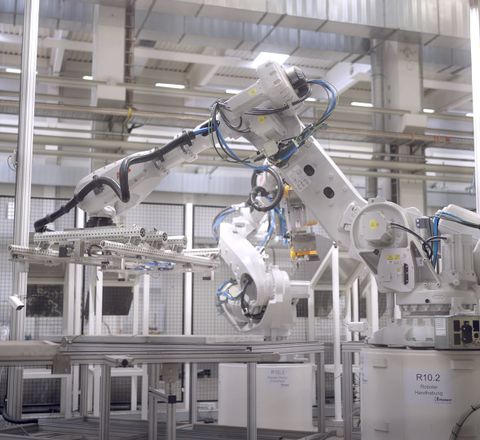
Five ABB IRB 6700 robots with IP67 protection class, SafeMove functionality and OmniCore control ensure precision and ergonomics in the preparation of the solar modules. Three robots in a securely fenced robot cell take care of handling in the front area of the system, while two others move along a traversing axis to the next processing stations.
The industrial robots grab the solar modules from the pallet and swing them out in a controlled manner to remove all the water. They also remove cables and junction boxes and transport the modules onwards. Bargel explains: "A gantry system would not have worked for us. We need full degrees of freedom because no two modules are the same."
According to Bargel, there are actually around 120,000 different types of solar module on the market. The ABB robots defy this diversity of variants: they are able to individually capture and adapt solar modules with a wide range of dimensions - without any time-consuming re-teaching. Each individual module is detected by an integrated machine vision system; the robot paths are adapted dynamically.

The hall in Magdeburg measures 25 × 120 m. Thanks to their many degrees of freedom, the ABB robot arms can also "turn corners" without the need for an additional conveyor system. This allowed the entire system to be compactly dimensioned.
Processing solar modules every minute
Six months after the start of the automation project, the line processes around 1200 modules per day. The target is 2,000 to 2,500 modules per day, with a planned cycle time of one minute per unit. A second line is being planned to increase the recycling capacity from 7000 to 21,000 tons per year.
"It is clear to us that if we want to industrialize the circular economy in the solar industry, we need systems that can handle the complexity of the input - and that are durable, low-maintenance and robust. This is exactly what the ABB robots achieve in our automated process," summarizes Jan Bargel.


You might also be interested in
When heat slows down production
Cooling concept for industrial halls with significantly reduced energy requirements
Infranorm is developing a cooling concept for industrial halls based on two-stage adiabatic cooling. According to the company, energy consumption can be reduced by up to 95 percent.
 read more...
Environmental technology as the industry of...
Ifat reports record figures for its 60th anniversary
Ifat Munich 2026 records record numbers with 3,400 exhibitors and 142,000 visitors The circular economy and water technologies are becoming key global industries.
read more...Sustainability needs decisions
To mark Earth Day, Nagarro is calling for a rethink: sustainability should no longer be documented, but actively managed - with artificial intelligence as a central lever. Because AI brings light into the darkness of global supply chains.
read more...Siemens Nanjing plant becomes Lighthouse Factory
The World Economic Forum has recognized the Siemens plant in Nanjing as a Lighthouse Factory. The factory was recognized for its AI-supported, fully digitalized production and significant improvements in productivity, quality and sustainability.
read more...Foundry modernizes plant park with continuous wire belt shot blasting system
The Spanish foundry Funosa is modernizing its equipment fleet with an RDGE 1250 wire belt continuous shot blasting machine from Rösler. Focus: sand removal from heavy iron castings, energy efficiency, ease of maintenance and ESG strategy.
read more...Maintenance instead of replacement
The circular economy starts with the machinery
Sustainability in industry starts with machines, says our guest author from Deguma: How maintenance, modernization and the 5R strategy save resources, energy and CO₂.
read more...Alpla continues to grow: 5.2 billion euros turnover
Alpla can look back on a successful financial year 2025 despite the difficult global economic situation. With revenue of 5.2 billion euros, the packaging and recycling specialist remains on course for growth.
read more...Interview with Prof. Dr. Vanessa Just
How sustainable is AI? Expert explains opportunities and limits
Artificial intelligence is changing the economy and society: but how sustainable is the AI boom really? In this interview, Prof. Dr. Vanessa Just talks about sustainable digitalization, responsible technologies and the role of the next generation in...
read more...Siemens Sustainability Report 2025
Sustainability successes in three impact areas
Siemens reports on significant progress within its DEGREE framework in its latest sustainability report. The company has made strong progress in decarbonization, resource efficiency and social responsibility.
read more...