

Shredding technology
What remains of the capsule
During the process of thermoforming espresso cups from multi-layer plastic films, rejects are produced. With process-integrated system solutions comprising extraction and shredding technology, Getecha ensures that this waste is directly removed and recycled.
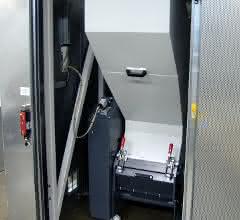
Of the approximately 1,200 coffee capsules that a modern thermoforming machine produces in 24 cycles per minute, a small percentage always gets stuck in the die due to the process. These are between two and five capsules made of multi-layer plastic film laminate per cycle. These faulty parts are driven out of the die by tilting and brushing, extracted, shredded and finally sent for recycling or interim storage in the silo.
To ensure that this disposal can be integrated into the process, run continuously and without disrupting production, plant manufacturer Getecha has developed a complete system solution comprising a suction unit, collecting hopper, granulator and piping. It is currently being implemented in quadruplicate for a large packaging manufacturer in the Netherlands.
Efficient and easy to maintain
The technical heart of these coffee capsule processing lines from Getecha are the grinders from the Aschaffenburg-based company's RS 2400 series of rotary cutters. Depending on the performance of the thermoformer and the number of capsules produced - 50 or 70 cups per cycle - this can be an RS 2404 with a standard rotor speed of up to 390 revolutions per minute or an RS 2406 with a customized rotor speed of up to 500 revolutions per minute.
Basically, these are shear cut hopper mills for hourly throughputs of up to 220 kg/h, which are often also used as central mills. They have a segment rotor with optimum cutting force distribution, a maintenance-friendly housing design (tool-free sieve removal, gas pressure spring opening of the hopper) and offer many customization options (rotor variants, wear protection). Getecha also offers the option of equipping the motor control of the grinders with its innovative Energysave function. This allows the energy consumption of the three-phase drives to be significantly reduced without restricting performance.
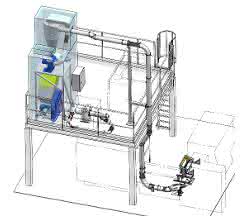
At the Dutch coffee capsule manufacturer, the rotary cutter grinders are located on elevated platforms above the thermoforming systems. This is also where the GA 500-S extraction systems from Getecha with their suction blowers, cyclones and rotary valves are located. The regrind is sucked in via a pipe around ten meters long, which leads from the thermoformer up to the second level to the feed hopper of the granulator.
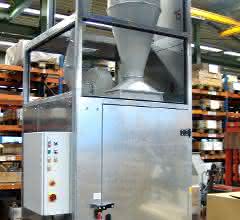
A cyclone is installed upstream of the hopper, which separates the faulty parts from the conveying air and feeds them to the grinding chamber of the mill via the rotary valve. The faulty parts from the thermoforming process are collected a few seconds after the faulty parts have fallen out of the die onto a conveyor belt and are fed into a collecting hopper. This collecting hopper - also a component of the Getecha system solution - is designed at the customer's request in such a way that it allows easy access to the faulty parts via a flap. This allows the quality control department to inspect the process at any time.
Relaxedcontinuity
Even with fluctuating volumes or production peaks, the coffee capsule shredding line from Getecha guarantees a uniform and complete collection of defective parts directly at the thermoforming system. The load-dependent control system and the automatic fill level signal of the granulator, as well as the option of material buffering in the granulator hopper, ensure relaxed continuity in the flow of ground material.
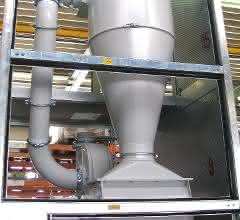
A bypass pipe to the blower of the thermoformer can also be used to regulate the amount of air for extracting the ground material from the mill for further processing. Starting up the thermoforming system is also a relaxed affair: where previously a hectic back and forth with containers tied up the manpower of three or even four people, one press of the start button is now enough to set the automated extraction and shredding machinery in motion. And as a contribution to improved ergonomics at the workplace, both the granulator and the extraction system have been fitted with additional sound insulation. as


You might also be interested in
Housing and inserts for plenty of power
Lapp presented the expansion of its Epic Power series at SPS 2023: four new M23 circular connector inserts and three new M23 housings. The special feature: all housings can be combined with any of the four inserts.
 read more...
News and product updates from Smartgas
Portable gas analyzers for outdoor use
Smartgas is starting the second half of the year with a series of updates to existing products and a number of new products. Portable analyzers expand the range of applications, while new accessories such as protective housings and heating modules...
read more...Everything accurate in switch cabinet construction
To ensure smooth work processes, tools for processing enclosures and housings must function flawlessly and reliably. Häwa rounds off its punching range with the Multi-Press 500.
read more...Shafts and conversion parts
The Rodriguez range includes ball bushings including matching housings, shaft brackets, crossbars and supports.
read more...Cooling and temperature control units
Hygienic packaging sells safely
In few industries are the requirements for hygiene in the production process as strict as in the food sector - the health of consumers has top priority. This results in enormous challenges for all machines and components involved, especially in...
read more...Simple tool change in seconds
With the CMS, Schunk is launching a user-friendly, manual change system for quick component replacement. In addition to its simple and convenient operation, the CMS also stands out with its extensive range of optional modules and complementary end...
read more...Motion controller for small drives
Medium power range covered
Faulhaber has another housing-less and compact motion controller in its range, which is particularly suitable for integration in device construction and medical technology applications.
read more...Welding solutions in the name of resource efficiency
At the Welding & Cutting trade fair in Essen (September 11-15), Fronius will be focusing on the major drivers in welding technology. Quality requirements are increasing in all industries, but the required welding specialists are scarce. In...
read more...Safe solutions for cable installations
From thick power cables to thin sensor lines, cables and lines must be routed safely through systems and machines. A challenge that should not be underestimated, explains Jörg Sokat, Head of Product Management at Pflitsch.
read more...