

Gripper technology
Sensor technology booming in gripping systems
Flexible, autonomous and networked handling systems are finding their way into production. In addition, the collaboration between man and machine is being revolutionized. For this to succeed, gripping systems are needed for the smart factory. Sensor technology is becoming increasingly important.
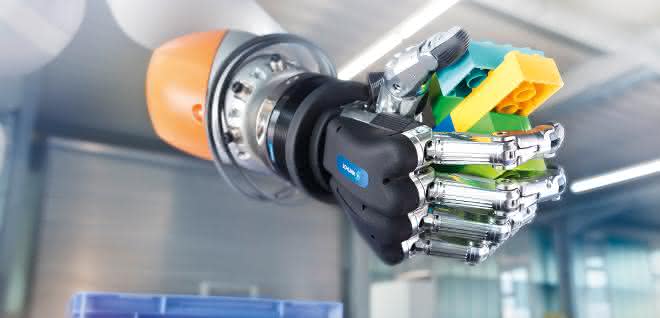
In recent years, sensor solutions for handling, assembly and robotics have made real leaps in development: they are becoming increasingly powerful, compact and universally usable. They often merge directly with the actuator and are comparatively easy to program.
Convenient position monitoring
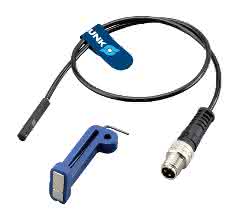
With the MMS 22-PI C-slot sensor, Schunk is pursuing the "one sensor fits all" strategy. The universal sensors have either one or two freely programmable switching points and are detected via a magnet inside the actuator. Instead of many different sensor variants, one or two are usually sufficient. This reduces warehousing and provides flexibility.
Compared to conventional magnetic switches, the set-up time is significantly reduced with the MMS 22-PI. Instead of laboriously setting the switching points mechanically, the sensors are quickly programmed using a teach tool. Process stability can be further increased by also defining the switch-off points if required. The hysteresis, in turn, is adjustable so that reliable position monitoring is possible even with very small strokes and the gripping process can be precisely evaluated and controlled.
The MMS-A analog position sensor, which according to Schunk is the first and smallest teachable analog sensor that can be integrated directly into the C-slot of gripper modules without interfering contours, is just as easy to use. It can be used to detect the entire stroke range of the gripper so that parts of different sizes can be precisely detected. Where previously several magnetic switches were usually required, the compact MMS-A with a diameter of four millimeters is now sufficient.
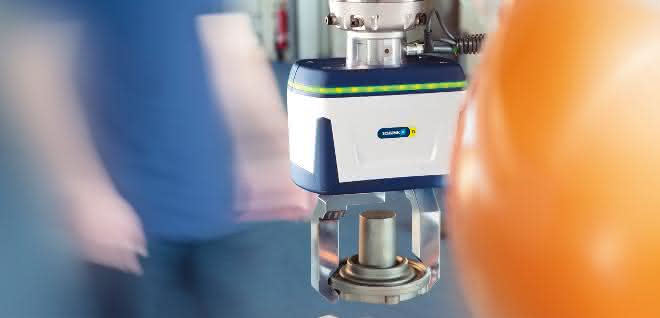
High-resolution, analogue sensors such as the APS-M1, which enables parts to be measured with a precision of up to 0.03 millimetres during handling, represent the upper class of positioning sensors. Any number of switching points can be defined via the PLC, allowing any number of parts or tolerance ranges to be distinguished.
IO-Link sensor provides additional information
With the MMS 22-IO-Link, the evaluation options of the pneumatic universal gripper PGN-plus-P and the pneumatic small parts gripper MPG-plus can be easily expanded. It is also simply placed in the C-slot and can detect the entire stroke range of the gripper, so that parts of different sizes can be detected precisely. Thanks to IO-Link, additional data can also be generated, such as the number of cycles, the evaluation quality or the sensor ID.
The catalog sensor is thus the spearhead for a new understanding of data in gripping: "The grippers of tomorrow will not only grip, they will also report back more and more data," says Schunk's Head of Development, Prof. Dr. Markus Glück, describing the current trend. "Even today, analog magnetic switches provide information on whether and, if so, which part has been gripped. In the future, the depth of this information will continue to increase."
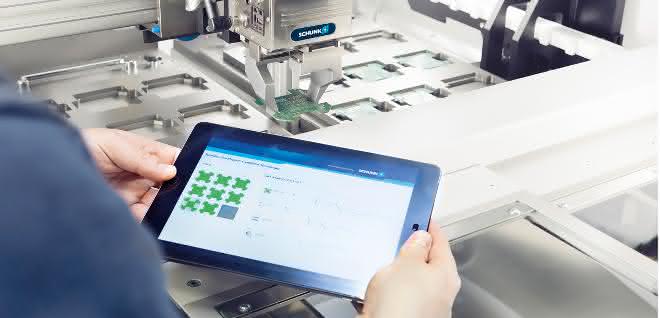
Sensor integration and fusion
Smart handling modules, such as the EGL, create the conditions for fully integrating production systems in the manufacturing environment and connecting them to cloud-based ecosystems. In technology studies, inline measuring systems collect data during smart gripping and evaluate it immediately with the help of edge technology integrated into the gripper. Each individual process step is monitored in detail and forwarded to the plant control system, the higher-level ERP system, analysis databases and cloud solutions, for example.
In this way, grippers are able to systematically record and process information about the gripped part, the process and also about the components and to carry out appropriate reactions. They thus enable closed-loop quality control and direct monitoring of the production process in the production cycle. As part of a sensor fusion, several sensors can be used in parallel and their measured values can be analyzed in a linked manner in order to evaluate the current system status of the grippers and the access situation. This makes it possible, for example, to detect gripping objects or faults in the production process.
Enabler for human-machine interaction
The intelligent use of sensors in gripping systems also enables decisive progress in human-robot collaboration (HRC): "In HRC applications, it is important to manage the balancing act between the requirements of the handling task and the biomechanical limit values defined in ISO/TS 15066," explains Markus Glück. Schunk is currently demonstrating how this can be achieved with the EGL-C large lifting gripper, which combines force measurement with displacement measurement: Force measuring jaws integrated into the base jaws and incremental encoders permanently monitor the gripping force and the position of the gripper fingers.
The gripping force is limited to 30 Newtons up to a theoretical distance of four millimetres from the taught workpiece, which is significantly less than the thickness of a finger. If a collision occurs during this approach phase, for example with the operator's hand, the gripper immediately comes to a safe stop without the risk of injury.
In the second phase of the gripping procedure, i.e. when the workpiece distance is less than four millimetres, the fingers close with a freely definable maximum force of up to 450 newtons - far more than was previously possible with collaborative grippers. If the system detects yielding during this closing phase, for example because a workpiece is gripped that is too small and the operator is about to remove it by hand, this movement also stops automatically. The same applies if the expected workpiece dimensions are exceeded by two millimetres, for example because no part is present.
Finally, in the third phase, the gripper detects whether the part is securely gripped and activates the integrated gripping force retention by applying the brake. This means that the gripped part cannot be lost even in the event of an emergency stop. In addition, no re-referencing is required in the event of a power failure.
Artificial intelligence
According to Schunk's plans, in future it should be possible to automate tasks for the entire kinematic chain consisting of robots and grippers without having to program them step by step. The key to this autonomous gripping is the use of artificial intelligence and the parallel use of different sensors.
In a pilot application, randomly arranged parts are identified by a camera, picked autonomously from a transport box and fed into a machining process. The system forwards the information obtained about the component to downstream stations so that, for example, an intelligent power clamping block is able to automatically adjust its stroke and gripping force to the next part. The idea is that the gripper will not only grip, but will also take over the entire gripping planning in conjunction with 2D and 3D cameras, monitor the process using sensors and communicate with upstream and downstream components. "In this context, it will be crucial that modern gripping system solutions have the appropriate sensor technology on the one hand and are prepared for the use of AI technologies on the other," emphasizes Glück. as


You might also be interested in
More than 900 exhibitors already registered
Around six months before the start of the trade fair, more than 900 companies have registered for SPS 2026 in Nuremberg. The trade fair focuses on industrial AI, cyber security and digital transformation.
 read more...
Virtual PLCs in practice: How vPLCs make production systems more flexible and scalable
The increasing networking of IT and OT is fundamentally changing industrial automation. The IT/OT Integration Summit shows how modern technologies can make production environments more efficient, flexible and future-proof. The event will focus on...
read more...Sales growth in a turbulent market environment
Thanks to innovations and a focus on strategic industrial markets, Sick was able to moderately increase its sales in the 2025 financial year. In a turbulent market environment, the company was able to maintain its position and gain market share with...
read more...Siemens presents new AI agent
Siemens is launching 'Eigen Engineering Agent', an AI for automation technology. The solution is integrated into the TIA Portal, has been tested with over 100 companies and is designed to significantly accelerate engineering processes.
read more...Schaeffler keeps sales almost stable
Schaeffler generated revenue of EUR 23.5 billion in 2025 and increased EBIT before special items to EUR 936 million. At 266 million euros, free cash flow was significantly above the prior year and forecast. Net income remained negative due to high...
read more...Advancing artificial intelligence together
Helukabel is stepping up its activities in the field of artificial intelligence and is now a member of the IPAI. The innovation and collaboration platform for companies, research facilities, institutions and administration has set itself the goal of...
read more...New impetus for ifm sales
Two new positions were filled at ifm at the start of 2026: Markus Wolf becomes Managing Director Sales Germany, Sven Quant takes over the position of Central Managing Director in the Process Sensors division within the ifm Group.
read more...Digital twin meets product passport
Future-proof end-to-end solution at SPS 2025
At SPS, conplement and R. STAHL will present how the digital twin works end-to-end along the entire value chain: from creation and provision to productive use.
read more...Changes in the management of Endress+Hauser
Endress+Hauser strengthens its management team: Mirko Lehmann, Katja Windt and Helena Svensson take on central management roles. What is changing in technology, production and personnel.
read more...