

Shredding lines
Foils from three rolls and stacks of plates
Two years ago, packaging manufacturer Pro-Pac built a new hall at its Vechta site with the aim of centralizing its shredding technology. The focus: complete solutions from Getecha.
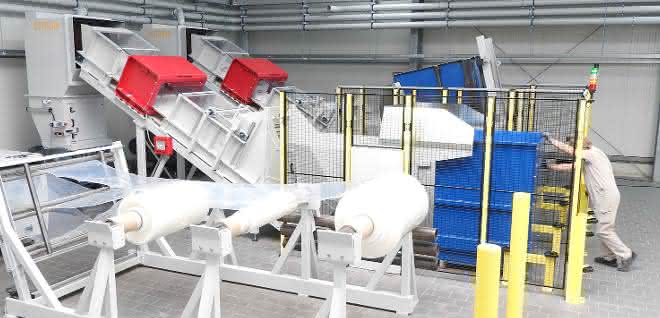
Providing consumer-friendly products for the packaging, protection and presentation of fresh food is the mission of plastics processor Pro-Pac. The plates, cups, tureens, mugs, boxes and trays are primarily produced in fully automated extrusion and thermoforming lines at the company's headquarters in Vechta, Lower Saxony. For technical reasons, this type of high-volume production generates considerable quantities of waste, faulty parts and start-up samples, which Pro-Pac shreds, processes and recycles.
In order to organize this circulation system as efficiently as possible directly on site and at the same time create space in production for further process optimizations, the company's management decided to centralize the shredding technology around three years ago - and had a new hall built specifically for this purpose. It went into operation in 2016 and offers space for up to six automated lines for shredding production and start-up waste.
High degree of automation required
Pro-Pac therefore contacted the Aschaffenburg-based company Getecha. The company already has a long-standing partnership with the Franconian granulator manufacturer. In the first stage of the project, the plan was to install two lines for shredding stacked thermoforming parts from the series production of white and transparent PP and PET containers as well as a third line for shredding PP film remnants of different thicknesses. In all three cases, the result was to be a complete solution. It was therefore not only necessary to select the appropriate hopper and feed granulators, but also to plan the complete input and output technology.
"Pro-Pac's task was complex. It involved embedding customized, modified shredding mills in a process technology environment consisting of conveyor and handling technology, metal detectors, exhaust air purification and filling and packaging technology - including the control and safety integration of all components, of course," says Andreas Lanz, Area Sales Manager at Getecha
Conveying, tilting, shredding
Two Getecha RS 45090 granulators were chosen for shredding the thermoformed parts. These modern hopper granulators are designed for throughputs of up to 900 kilograms per hour and also have optional grinding housings with highly effective sound insulation. Due to their upward-mounted drive integrated into the housing, they are compact and require only a relatively small footprint. In principle, an RS 45090 can be equipped with additional bypass hoppers for the synchronous feeding of pipes, profiles and sheets. It can therefore be used flexibly.
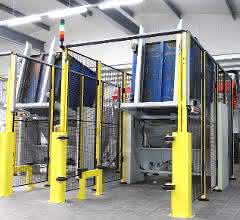
The prerequisite for this is the powerful 3-blade rotor - it picks up voluminous plastic residues very well - and the use of two stator blades in the grinder. A hydraulic opening mechanism facilitates access to the screen box, and an electrically monitored rotor blockade makes routine knife changes a simple and safe matter. Tailor-made for use at Pro-Pac, the grinders were fitted with a fixed hopper with a large access door. This saved additional space.
"Homogeneous material flow"
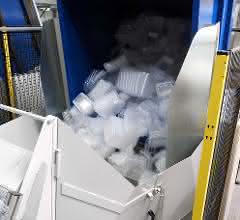
Getecha designed the starting point of the process as a safety gate with a fully automatic tilting device. Here, the full collection containers from production are rolled into the feed position by an employee and tipped fully automatically into a transfer hopper - at up to around 132 degrees and until the defined degree of emptying is reached. An integrated vibration system can be switched on for support. The container is then lowered again, removed and rolled back into series production.
From the transfer hopper, the drinking cups, plates and bowls to be ground are transferred to a conveyor belt, where a driven scraper roller separates any missing parts that are stuck together. Also important: "As the collection containers come directly from production, they can contain metal parts that would both damage the equipment and contaminate the ground material. To rule this out, there is a tunnel detector with a double-layer metal detection coil above the conveyor belt, which reliably detects all metallic particles and - if necessary - interrupts the feed," reports Andreas Lanz from Getecha. This ensures that a homogeneous and continuous flow of material is conveyed towards the mill hopper.
To ensure that the area around the shredding line also remains clean, Getecha has enclosed the conveyor belts on all sides with a transparent plastic cover. This means that no material can fall off the conveyor belt. However, flaps above and below the metal detector allow easy access to the conveyor belt - for example, for manual removal of metal contaminants. Largely separated, the material finally falls into the hoppers of the two RS 45090s and is crushed into particles with diameters of 6 mm in their grinding units.
Process reliability and energy efficiency
To prevent the grinders from being overloaded in the event of high material volumes, the company equipped the Pro-Pac lines with its LAS system for load-dependent time-out of the material feeds. Andreas Lanz explains: "The control system constantly monitors the power consumption of the grinder. If a previously defined limit value is exceeded for too long, the belt conveyor switches off temporarily. If the power requirement drops, it picks up speed again - it all happens fully automatically." The level monitoring of the mills has the same effect. Here, light barriers signal the control system when the hopper threatens to fill up.
For Kurt Wördemann from Pro-Pac, the Energy Save System (ESS) is also a plus. Getecha has been equipping almost all larger Roto cutter models with this for a good three years. "This function reduces the power consumption of the grinders under partial load and when idling. In addition, the soft start of the ESS prevents damaging current peaks during the start-up phase, which also protects all mechanical components," reports the operations manager.
From the uncoiler to the double infeed
Both an overload cut-off and Getecha's innovative Energy Save System can also be found in the RS 3012 E infeed granulator, which forms the centerpiece of the third shredding line in Pro-Pac's processing center. Andreas Lanz's task here was to plan a complete system solution in which up to three rolls of PP film remnants from thermoforming were to be fed into an efficient shredding process.
The RS 3012 E is a representative of a series of feed granulators from Getecha that is suitable for shredding solid films, edge trims and punching grids from thermoforming. The rotor of these machines has a cutting circle of 300 millimetres and is operated as standard with cutting lengths between 410 and 1,575 millimetres. The reel feeds have widths of around 100 to approx. 1,550 millimetres and are available in different versions.
In Pro-Pac's processing center, the RotoSchneider infeed granulator is used in a particularly wear-protected version with a double infeed, via which films of different thicknesses can be fed in at varying speeds. In front of this is a phalanx of three unwinding stands of different heights. This is where the forklifts approaching from production place the rolls with the remaining film. An employee then guides the beginning of the film through the film end detection system to the feed slot of the granulator. Everything else happens automatically.
Automatic speed control
The actual shredding process of the RS 3012 E then runs extremely smoothly and harmoniously - especially as the granulator used at Pro-Pac has an intelligent system for regulating the speed of the feeds for the offline shredding of extruded films. This development from Getecha makes it possible to automatically adjust the feed speed of several synchronously fed films - depending on the performance required for shredding and at the same time taking into account the fluctuating regrind volume depending on the film thickness.
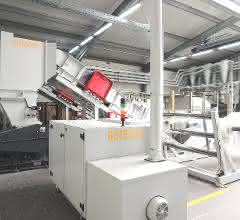
The rotor speed of 420 revolutions per minute and a special screen with diagonally drilled holes counteract the formation of unwanted long pieces in the regrind, even with a slow feed. "For many years, a bow control system with a dancer arm, which synchronized the speed of the feed with the speed of the film line and regulated the tensile load on the film, proved its worth here. However, our new solution works more precisely, is more compact and, above all, ensures optimum throughput and a very high regrind quality," explains Andreas Lanz.
Alternatively, the feed speed can always be preselected manually. Getecha also offers various control systems for its feed grinders to adjust the feed speed - for example for inline shredding downstream of the extrusion line or for shredding edge trims.
Fresh regrind for production
All three grinding lines and a further mill from the Pro-Pac stock, adapted by Getecha Engineering, are connected to a vacuum-pressure conveying system (Getecha System GA 1000) with regrind and exhaust air dedusting. The exhaust air is separated via a cyclone and only released into the environment via exhaust air filters after cleaning. The ground material from the cyclone - dosed via a rotary feeder - ends up in customer containers whose fill level is monitored by ultrasonic sensors. When a container is full, an optical signal is given and the conveyor belt of the respective RS 45090 or the infeed system of the RS 3012 E moves down until the container has been replaced. as


You might also be interested in
Housing and inserts for plenty of power
Lapp presented the expansion of its Epic Power series at SPS 2023: four new M23 circular connector inserts and three new M23 housings. The special feature: all housings can be combined with any of the four inserts.
 read more...
News and product updates from Smartgas
Portable gas analyzers for outdoor use
Smartgas is starting the second half of the year with a series of updates to existing products and a number of new products. Portable analyzers expand the range of applications, while new accessories such as protective housings and heating modules...
read more...Everything accurate in switch cabinet construction
To ensure smooth work processes, tools for processing enclosures and housings must function flawlessly and reliably. Häwa rounds off its punching range with the Multi-Press 500.
read more...Shafts and conversion parts
The Rodriguez range includes ball bushings including matching housings, shaft brackets, crossbars and supports.
read more...Cooling and temperature control units
Hygienic packaging sells safely
In few industries are the requirements for hygiene in the production process as strict as in the food sector - the health of consumers has top priority. This results in enormous challenges for all machines and components involved, especially in...
read more...Simple tool change in seconds
With the CMS, Schunk is launching a user-friendly, manual change system for quick component replacement. In addition to its simple and convenient operation, the CMS also stands out with its extensive range of optional modules and complementary end...
read more...Motion controller for small drives
Medium power range covered
Faulhaber has another housing-less and compact motion controller in its range, which is particularly suitable for integration in device construction and medical technology applications.
read more...Welding solutions in the name of resource efficiency
At the Welding & Cutting trade fair in Essen (September 11-15), Fronius will be focusing on the major drivers in welding technology. Quality requirements are increasing in all industries, but the required welding specialists are scarce. In...
read more...Safe solutions for cable installations
From thick power cables to thin sensor lines, cables and lines must be routed safely through systems and machines. A challenge that should not be underestimated, explains Jörg Sokat, Head of Product Management at Pflitsch.
read more...