

Ergojack soft orthosis
Soft robot recognizes incorrect posture
Fraunhofer researchers have developed the Ergojack soft orthosis to combat back pain caused by physically strenuous movements.
Ergojack is a "wearable soft robotics system". Researchers at the Fraunhofer Institutes for Production Systems and Design Technology IPK and for Reliability and Microintegration IZM in Berlin have developed a soft orthosis that relieves strain on the back and encourages workers to perform strenuous movements ergonomically.
Not a conventional exoskeleton
The unique selling point of the soft robotic upper body orthosis is real-time movement analysis. Specially developed algorithms based on machine learning and AI enable the ergonomics analysis. This distinguishes the orthosis from previous exoskeletons - i.e. support robots that, in principle, simply provide power support for all movements, including non-ergonomic ones, and merely redirect the wearer's stress forces from overloaded to less stressed areas of the body. The movement analysis of the IPK orthosis, on the other hand, recognizes ergonomic and non-ergonomic movements. The wearer receives real-time feedback via a vibration alarm if they adopt postures or perform movements that are harmful to their health.
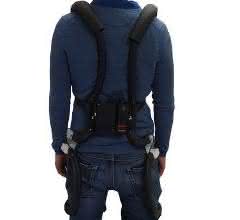
AI in the vest
Inertial movement sensors (Inertial Measurement Unit IMU) integrated into the vest compare pre-learned movement patterns with the actual movement and evaluate them in real time; this takes just a few hundred milliseconds. The miniaturized movement sensors are located on the shoulders, back and thighs. In addition to these sensors, robust, miniaturized electronics including an embedded controller, a vibration module and a rechargeable battery are integrated into the orthosis. Fraunhofer IZM is responsible for developing the miniaturized electronic components, while Fraunhofer IPK is responsible for designing the system layout, human-system interface, mechanics, electronics and software, including the real-time algorithm with machine learning and artificial intelligence.
Variants and further developments
Data processing runs directly on the vest. The training process only requires a small movement training data set. The Fraunhofer researchers are working on encapsulating the electronics and sensors of the textile version of the orthosis in such a way that they are washable and do not have to be removed from the vest. In future, customers will be able to choose between a purely sensory textile vest and a version with power assistance.
Another current system variant with back and hip support was designed with a minimal orthosis support surface on the body. The power transmission from the back to the legs can be switched on and off using a lockable lateral hip joint on the vest. This mechanism enables alternating activities while standing and sitting. pb


You might also be interested in
AI automation specialist reorganizes...
Generation change at Insiders Technologies
After almost 30 years at the helm, Werner Weiss is handing over the management of Insiders Technologies. Andree Albrecht takes over the management after a transition phase.
 read more...
Intelligent brownfield networking
Many industrial companies are struggling with established plant structures and proprietary interfaces. Stefan Klaus' presentation will show in a practical way how brownfield environments can be efficiently networked with open technologies and made...
read more...Factory-X in practice
How can set-up processes in highly variant production be automated efficiently? Markus Benndorff from soffico shows how Factory-X, industrial data rooms and modular architectures create new possibilities for flexible production concepts.
read more...Quality controls in production
Robots check car floor pans fully automatically
How can complex components in automotive production be inspected fully automatically and in real time with the help of machine vision and robotics? The case study shows how floor pans are measured and inspected fully automatically.
read more...Measurement software with integrated calibration wizard
The WinControl measurement software from Ahlborn is designed for the acquisition and processing of measurement data with Almemo measuring devices and offers functions for complex calibration tasks. A graphical user interface and context-sensitive...
read more...New platform facilitates chip design
Siemens opens access to EDA software in Europe
Siemens is cooperating with the Chips JU within the framework of EuroCDP and is facilitating access to modern EDA software for chip design, development and innovation for European companies. The aim is to strengthen start-ups, SMEs and research...
read more...AI and virtual twins for the industry
Dassault Systèmes confirms annual forecast after solid start to 2026
The French software group Dassault Systèmes has made a solid start to 2026 and is continuing to focus on artificial intelligence, cloud applications and virtual twins as growth drivers in its industrial business.
read more...Use data consistently and uniformly
New connectors and an app solution for the IIoT framework from PLCnext Technology make it easier to collect data from controllers, sensors and field devices - especially in existing systems.
read more...How companies can prevent cyberattacks
Instead of using traditional malware, attackers use legitimate programs and system tools within their victims' IT environments. Malicious behavior can hardly be distinguished from normal user behavior. For companies, this means that security...
read more...