

Workpiece clamping
Virtual clamping planning reduces rejects
Nowadays, the planning of workpiece clamping and the clamping devices used is usually carried out completely manually and iteratively. Multiple iteration loops result in high set-up costs as well as costs for the necessary test components.
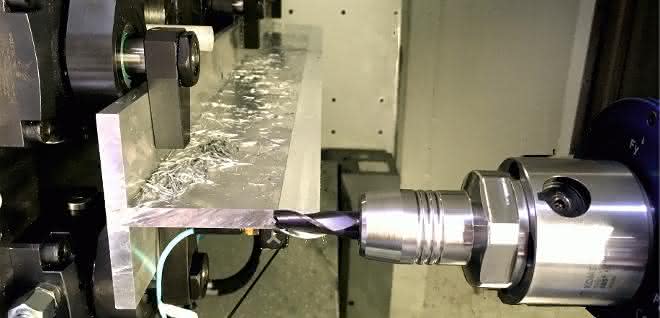
The Institute of Production Engineering and Machine Tools (IFW) at Leibniz Universität Hannover is developing a tool for virtual clamping planning that can be used to automatically derive the optimum workpiece clamping with regard to suitable economic and technological criteria. This reduces production and set-up costs as well as waste and eliminates unnecessary clamping devices.
Challenges in clamping planning
Particularly with long and flexible workpieces, a large number of clamping points for clamping and support elements are usually provided during clamping planning in order to reduce the process-related deformation of the workpiece. However, a large number of clamping elements leads to high acquisition costs and increased set-up times. In addition, the higher number of clamping elements has a negative impact on the accessibility of the workpiece for the tool due to the increase in interfering contours. On the other hand, too few clamping elements can lead to process instabilities, such as chattering or loosening of the workpiece and thus damage to the machine.
In addition to secure clamping, the clamping elements are also used to stiffen and support the workpiece. In the case of experience-based clamping planning, too many clamping elements tend to be used for secure workpiece clamping. Due to the high number of clamping elements, increased effort is required for iterative set-up steps in work preparation and corresponding staff expertise. This is associated with high costs.
Partial automation through virtual clamping planning
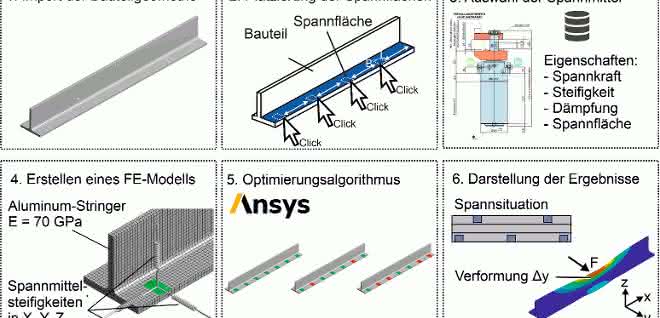
The virtual clamping planning process developed at the IFW is divided into six semi-automated steps. A flow chart is shown in Figure 1. First, the design of the desired component is imported into the free CAD kernel OpenCascade (step 1). First, the operator defines the possible clamping surfaces on the component surface (step 2) and selects the desired clamping devices from a clamping device database (step 3). In addition, the previously estimated process forces during machining and the target criterion for optimizing the clamping configuration are defined. An exemplary criterion is the maximum permissible displacement, which is derived on the basis of the required tolerance accuracy of the component. A simulation model is created on the basis of the defined boundary conditions and a finite element model is automatically created in the Ansys Workbench simulation environment (step 4).
Alternatively, other simulation environments can also be used. The selected clamping devices are modeled as spring-damper elements with stiffnesses and damping of the real clamping devices. The necessary information about the mechanical properties of the clamping devices is automatically taken from a database that has to be created in advance. An optimization algorithm checks the effects of a large number of different clamping point combinations on the predefined target criterion (step 5). The algorithm terminates when the target criterion is reached and displays the optimum result of the clamping planning in a graphical representation. If, for example, a maximum permissible displacement of the component has been defined as the target criterion, the displacement of the component is displayed at the defined process force and the optimized clamping (step 6).
Practical application of virtual clamping planning
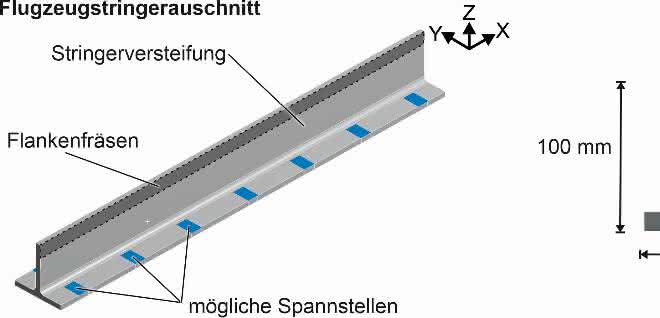
In order to assess the potential of virtual clamping planning to simplify planning, the method presented was carried out as an example prior to machining a component. An aircraft stringer analogue component (Fig. 2) made of an aluminum wrought alloy EN AW-6060 was defined for machining. The stringer has the dimensions B = H = 100 mm and a wall thickness of w = 10 mm with a length of 800 mm. Due to the geometry, the cut-out is susceptible to impermissibly high displacement of the workpiece during machining.
The stringer experiences the highest displacement at the vertical stiffener, particularly at the two ends and at positions with a large distance to the next clamping element due to the high compliance. High deflection has a negative effect on the dimensional accuracy, which in turn can lead to rejects.
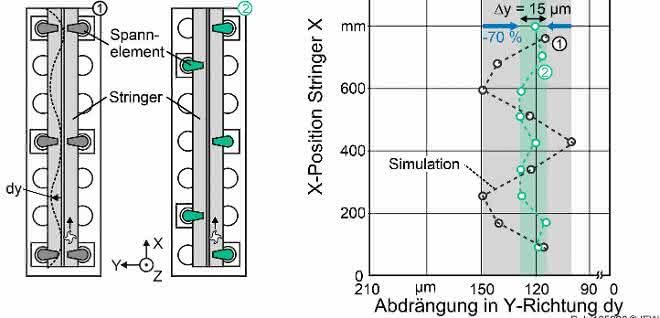
For this reason, experience-based clamping planning is carried out for the comparison with virtually optimized workpiece clamping, in which six clamping elements are positioned symmetrically at both ends and in the middle of the stringer as shown in Figure 3 (left), thereby clamping the points with a high expected displacement of the stringer. A flank milling process was defined as the machining process on the vertical flank of the stringer, as potentially high displacements occur here. A displacement force of FP = 400 N in the Y-direction could be estimated for the evaluation algorithm of the virtual clamping planning.
On the one hand, the same or a smaller number of clamping elements should be required than for experience-based workpiece clamping. On the other hand, a minimum process-related displacement of the stringer should be achieved. The lateral deflection of the stringer stiffener was used as a criterion for evaluating the stringer clamping. Figure 3 shows the experience-based and the workpiece clamping optimized by the virtual clamping planning. The adjacent diagram shows the simulated displacement of the stringer in the Y-direction dy over the length of the stringer in the X-direction.
The experience-based workpiece clamping shows the lowest displacement at the positions of the clamping elements with dy = 100 µm. In the areas between the clamping elements, on the other hand, the maximum displacements are dy = 150 µm, resulting in an average displacement dym = 130 µm. The calculated flatness of the stringer stiffener is therefore Δy = 50 µm. In contrast, a minimum displacement of dy = 115 µm and a maximum displacement of dy = 130 µm were calculated for the optimized workpiece clamping. At dym = 125 µm, this results in an average displacement that is 4 percent lower than with the experience-based clamping. In addition, the profile has a more even profile, resulting in a 70 percent reduction in the flatness of the stringer stiffener with only Δy = 15 µm.
Based on the simulation results, it can be stated that the virtual clamping planning made it possible to identify a clamping with fewer swing clamps, for which a significantly lower and more even displacement is predicted.
In practice, this means that there is less variation in the displacement at the stringer stiffener, which significantly reduces the maximum error. Furthermore, the set-up effort can be reduced due to fewer clamping devices and the component quality can be increased at the same time. Finally, it should be noted that displacement of the stringer stiffener cannot be completely avoided with the clamping elements used because they only clamp the stringer at the base. This deflection, which cannot be influenced, accounts for a significant proportion of the calculated deflection of the stringer stiffener in the Y direction. Even when clamping at all possible clamping points, there is therefore a deflection at the stringer stiffener that corresponds to around 100 µm.
Verification of the stress planning algorithm
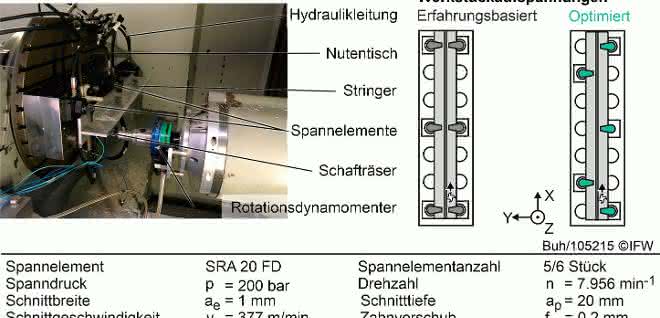
To verify the simulation results, the flank milling process was carried out on a DMU 125P milling center with a type 3677-12.00 end mill. The process forces on the milling cutter were detected in parallel with the process using a 9123 C rotational dynamometer from Kistler Instrumente GmbH. In addition, the vibrations on the workpiece were recorded using a PCB 356A16 accelerometer. Figure 4 shows the test setup and the set process variables.
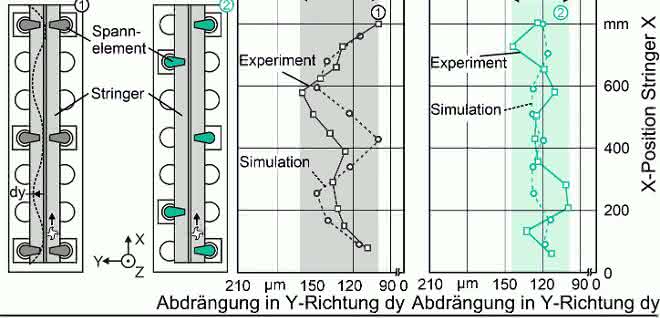
During the machining process, the rotational dynamometer detected displacement forces in the Y-direction between F = 400 - 450 N for both clampings. To compare the displacement of the milled flank of both workpiece clampings, the actual displacement in the Y-direction was measured on the milled surface using a machine probe. The simulated (Figure 3) and the measured displacement are shown in Figure 5. For the experience-based clamping, a minimum displacement of dy = 100 µm and a maximum displacement of dy = 170 µm were detected, resulting in an average displacement of dym = 135 µm in the Y direction.
Consequently, there is an average deviation of 3.8 % between the simulated and experimentally determined displacements. The machined surface has a wavy profile with a flatness of Δy = 70 µm and thus deviates 20 % from the simulated results. A minimum displacement of dy = 100 µm was also detected with the optimized clamping. With a maximum deviation of dy = 145 µm, this results in an average displacement of dym = 123 µm in the Y direction. The flatness of the machined stringer stiffener is Δy = 45 µm. Experiments have thus shown that the optimized workpiece clamping can produce a 9.8 % lower mean displacement and a 35.7 % lower scatter in flatness compared to the experience-based clamping. However, as already explained, it is not possible to achieve complete suppression of the deflection by varying the clamping element arrangement.
The comparison between the simulated and measured results shows that the mean displacement in both stresses is mapped with a deviation of less than 4 %. The absolute deviations between the simulated and measured results can be attributed to the discrepancy between the experimental and simulated boundary conditions. In the simulation, idealized boundary conditions can be precisely defined and applied uniformly at all clamping points.
In contrast, the boundary conditions at the clamping points (clamping force, clamping surface, rigidity) are not the same everywhere during the test. On the one hand, this leads to deviations in the overall rigidity of the clamped workpiece. On the other hand, the inequality of all clamping points causes initial deformations of the workpiece (clamping distortion) that do not occur in the simulation. These effects lead to deviations between the simulated and experimentally determined workpiece displacement.
Summary and outlook
A tool for virtual clamping planning was developed at the IFW, with which a workpiece clamping is created semi-automatically. The developed tool can be used to estimate the displacements that occur during machining. This allows the workpiece clamping to be optimized with regard to low form deviation and a small number of clamping elements. The virtual clamping planning method can therefore potentially reduce the effort required for setting up and setting up the process as well as the effort required for possible reworking of the workpiece. In the future, it is planned to extend the presented method to more complex components.
Acknowledgments
The IGF project "Methods for virtual clamping planning in work preparation", IGF project no. 19591 N/1, was funded by the Federal Ministry for Economic Affairs and Energy via the AiF as part of the program for the promotion of joint industrial research (IGF) on the basis of a resolution of the German Bundestag. The IFW would like to expressly thank the sponsors for their financial support in this project. The IFW would also like to thank its industrial partners on the project support committee, who have provided valuable support for the research project. Without this cooperation, practice-oriented research would not be possible.
Prof. Dr.-Ing. Berend Denkena, Head of IFW; Dr.-Ing. Benjamin Bergmann, Head of Machines and Controls, IFW; Henning Buhl, M.Sc. Staff member; M.Sc. Markus Claßen, research assistant; M.Sc. Staff member; M.Sc. Christian Teige, research assistant. Assistant, all in the Machines and Controls department, IFW


You might also be interested in
Free online tools from ACE in practice
In many companies, digitalization and the lean management approach are seen as a welcome slimming cure. How digital progress is simplifying design processes is demonstrated above all by solutions designed from the user's perspective. Configuration...
 read more...
ACE small shock absorbers secure wheelchair test bench
The demands on the quality and functional safety of wheelchairs are high. This also applies to the test series carried out by manufacturers during the development or further development of models. As part of their training, three mechanical...
read more...E-scooter with customizable damping
The startup Scuddy has significantly improved the flexibility, performance, customizability and ergonomics of its second-generation foldable e-scooter of the same name - thanks in part to damping technology from ACE.
read more...ACE vibration dampers: protected against vibrations step by step
Autonomous driving - what is still being perfected for road traffic is already part of everyday life when it comes to transporting materials from the warehouse to assembly. In fact, manufacturer-independent special kits for converting commercially...
read more...Key factor: energy efficiency
Sumitomo Drive Technologies, together with Invertek Drives and the Lafert Group, will be presenting its complete drive solutions for automation and Industry 4.0. Visitors to the stand will learn how they can achieve their sustainability goals and...
read more...ACE structural and crash dampers: Safety on the road 7
The seventh axis is used in manufacturing and production systems to make robots more agile and increase their reach. As an additional traversing axis, this linear axis brings robots quickly into the workspace or guides them precisely to parallel...
read more...Mechanical and plant engineering
Incoming orders in November: economic dampener takes effect
In the final months of 2022, the various economic downturns were also reflected in the order books of the mechanical and plant engineering sector.
read more...Safe protection for handling systems
Small shock absorbers protect linear axes in the semiconductor industry.
read more...ACE TUBUS structural dampers protect compact sliders
The requirements in automotive manufacturing in terms of product quality, precision and durability are high. Design engineers at voestalpine Camtec GmbH have therefore opted for structural dampers from ACE to protect compact slides.
read more...